
Dec. 2026
Ben Shragge
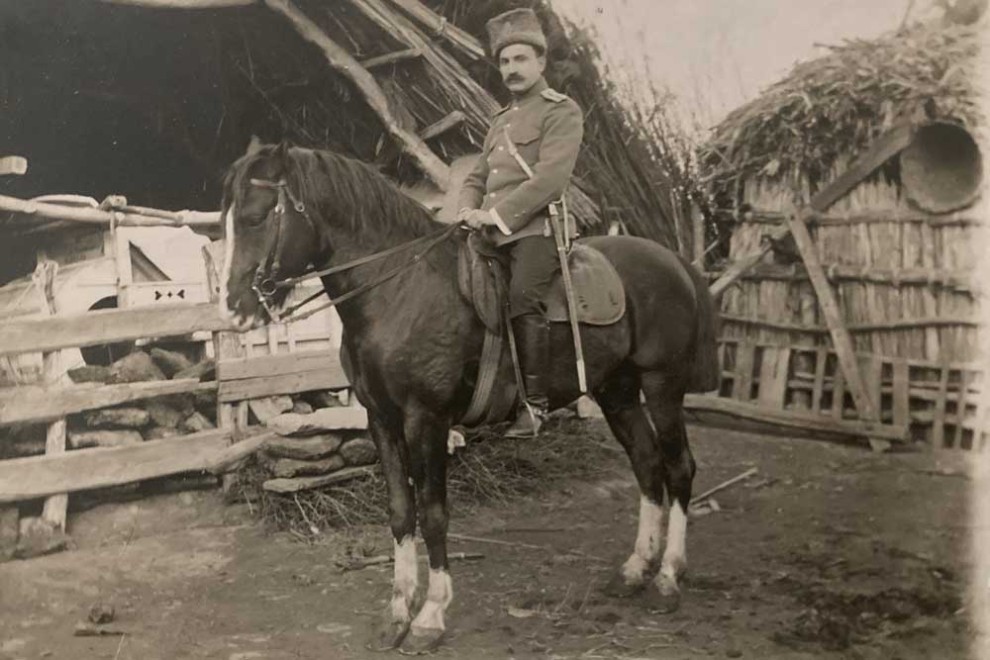
In the old photograph, mounted on a decorative card, a gallant, mustachioed man sits astride a horse in a farmyard. He wears a tall fur cap and the uniform of the Russian Imperial Army, with a strap across his chest that holds a sword. On the back of the card, written in pre-revolutionary Russian script, reads the following inscription:
To dear Abram and Manya,
from their loving brother,
Dr. Petrushkin.
18 March 1916
Odessa
Abram was my late father’s maternal grandfather, and Manya (the Russian diminutive for Mary, or Merka in Yiddish) was his maternal grandmother and Dr. Lazar Petrushkin’s sister.
My father, a cardiac surgeon, cherished this photograph of his great-uncle and fellow physician. He would recall how difficult it was for Jews in Tsarist Russia to attend medical school. Born in 1888, Dr. Petrushkin would’ve felt the full impact of antisemitic legislation that, among other injustices, limited the number of Jews who could pursue higher education. At the time, most Russian Jews lived in the Pale of Settlement, which included Odessa along with much of today’s Ukraine, and were generally restricted from moving elsewhere within the Russian Empire. Though Jews were roughly a third of Odessa’s population, they were only allowed to make up 10% of secondary school students per the Pale’s quotas. Dr. Petrushkin must’ve been an exemplary student to beat those odds.
In the late 19th and early 20th centuries, over two million Jews fled the officially antisemitic, pogrom-riven Russian Empire. Among them were Abram and Mary, who arrived in Winnipeg, Canada, in 1910. Dr. Petrushkin, however, stayed in Odessa and served as an army doctor following the outbreak of World War I in 1914. According to the Russian State Military Archive, he was posted to the 449th Kharkov Infantry Regiment and recommended for the Order of St. Anne, 3rd Class with Swords and Bow, for military valor in 1917. (Due to the Russian Revolution, Dr. Petrushkin likely never received the medal.) Presumably, the photograph was taken during Dr. Petrushkin’s army service, then mailed to his relatives in Canada.
Following what was then called the Great War, most of the world—including the United States and Canada—largely shut its doors to immigrants. The Russian Empire itself collapsed in 1917 and was ultimately succeeded by the USSR in 1922. Had Dr. Petrushkin wanted to join his sister and brother-in-law in Winnipeg, it would have been extremely difficult for him to have done so. That window of opportunity had closed.
Unfortunately, I know little about Dr. Petrushkin’s life in the Soviet Union, though the historical record tragically continues when Odessa fell to the Axis in 1941. For him, as for the third of the world’s Jewish population that perished in the Holocaust, remaining in Europe would prove to be a death sentence.
Odessa was conquered and governed mainly by Romania, an ally of Nazi Germany, though German forces were present and Nazi policy helped shape the fate of its Jews. During and after World War II, the Jewish writers Vasily Grossman and Ilya Ehrenburg compiled The Black Book of Soviet Jewry, a documentary record of the Holocaust in the USSR—though the Soviet authorities ultimately blocked its publication amid increasing state antisemitism. The authors describe the Slobodka ghetto, where Odessa Jews were condemned to live in squalor before being deported to their deaths. They also relate the following account of one of the ghetto’s more famous inhabitants:
Here is another one: a tall, thin man with a white beard and bright, intelligent eyes. Why are women accompanying him with looks of gratitude and furtively wiping away tears? What mother does not know him? Which of them is not thankful to him for the life of a child whom he had saved? This is Dr. Petrushkin, an old pediatrician, who had not managed to get out of Odessa in time.
In an email he once shared with me, my father noted that “I have forced myself to read the entire piece several times and shudder.” However, to my knowledge, my father was unaware of even more startling details about Dr. Petrushkin’s life and fate that I’ve uncovered via further research.
Adding more color to the account in the Black Book, Anatoly Nastasyuk, then a schoolboy in Odessa, recounts seeing Dr. Petrushkin in a column of Jews marched under guard toward the ghetto. He calls him “a famous doctor” and a “selfless man,” writing that “‘If Petrushkin said...’ was practically a password” in Odessa. Nastasyuk shouted, “They’re taking Petrushkin away!” and ran after the column with food to give him, but couldn’t find the pediatrician he had recognized by his black bowler hat, pince-nez, and distinctive doctor’s bag.
In his 2016 memoir How I Survived Holocaust in Odessa, Joseph S. Vergilis recalls that the Romanian occupiers established a Jewish Committee, which organized a hospital led by Dr. Petrushkin, whom he calls “a very famous pediatrician in Odessa before the war.” Survivor Leonid Dusman likewise remembers him as a legend of pre-war Odessa, and recalls that he and his fellow physicians performed simple surgeries, treated frostbite, and provided what medication, food, and moral support they could in the ghetto. In Antonescu’s City (2017), survivors Yakov Verhovsky and Valentina Tyrmos write that
through the committee's efforts, a Jewish hospital was established in the former tuberculosis hospital. Its chief physician was Dr. Petrushkin, beloved by all of us, the children of Odessa. We remember this kind, mustachioed man well, his enormous gold watch on a chain and his leather briefcase, from which, like a magician, he would produce a straw, a spoon, or a small round mirror with a hole in the middle. And even today, when our grandchildren drink cough syrup, we reminisce about childhood and call it “Grandfather Petrushkin's Drops.”
Yet as the Romanians liquidated Slobodka, Vergilis explains that the administration aimed to prepare the sick Jews for deportation, so doctors had to choose between sending their own patients to their deaths and seeing the hospital destroyed. He writes that “Some doctors could not bring themselves to make such a dreadful decision and they went together with their patients. Among the doctors who acted in such a manner were the famous doctor Petrushkin...”
Dr. Petrushkin was deported to Mostovoye, an execution and transit site in southern Ukraine. I was stunned to find the testimony of Ilya Marmerstein, another survivor who met him there in early 1942, as quoted in Leonid Sushon’s Transnistria: Jews in Hell (1998):
The first thing I saw from afar was a familiar man standing there. I peered at him eagerly, feeling timid about meeting him in these circumstances.
But suddenly it seemed: maybe I'm wrong... could it really be he, the famous Petrushkin? And immediately the involuntary joy vanished: it meant he, too, hadn't escaped the same fate...
Yes, I wasn't mistaken: it was he... definitely the one I met in Slobodka, in the ghetto in Odessa. Pediatrician Petrushkin, who was said to be known by many in Odessa, and who enjoyed great popularity. Now this unfortunate man stood here, in the courtyard of the Mostovoye transit point—he stood there, thin and pale, tall, narrow-shouldered, in a summer coat and hat, and his eyes expressed great sadness. He stared intently at one spot—the very spot from which countless people were sent every day to certain death. He looked with the gaze of someone compassionate and also doomed...
On a fated day in March, Marmerstein recalls Dr. Petrushkin gazing at the sky, with fine weather approaching, and remarking, “We must endure and wait, without losing hope!” They then heard gunshots from the street. German policemen had burst into Mostovoye, seizing goods from the Jews and gathering them into the courtyard. The Jews were then driven into a column through the gates, with Dr. Petrushkin “in one of the first ranks.” As Marmerstein recounts, “The column moved silently—people didn't speak, only the occasional cry of a child could be heard. ‘How far are you going to drive us?’ I heard someone ask a policeman. He replied: about five kilometers. And that meant they had only a few hours left to live.”
Miraculously, Marmerstein managed to save himself by slipping unnoticed into a crowd of peasants watching with sympathy. But Dr. Petrushkin and the other Jews—men, women, and children—were taken to an anti-tank ditch near the village of Vesyolyi Khutor and executed.
In the Romanian-run Transnistria Governorate as a whole, of which Odessa was the capital, an estimated 280,000 to 380,000 Jews were murdered during the Holocaust. Each one of them had a story, like Dr. Petrushkin’s, that deserves to be remembered. I know his legacy as a physician inspired my father’s professional calling, and when I look at his photograph and reflect on the noble life he lived, I, too, am moved. In the face of unspeakable evil, he acted with moral courage and unshakable dignity. I will not forget Dr. Lazar Petrushkin.
