
Sept. 2026
Wendy Schneider
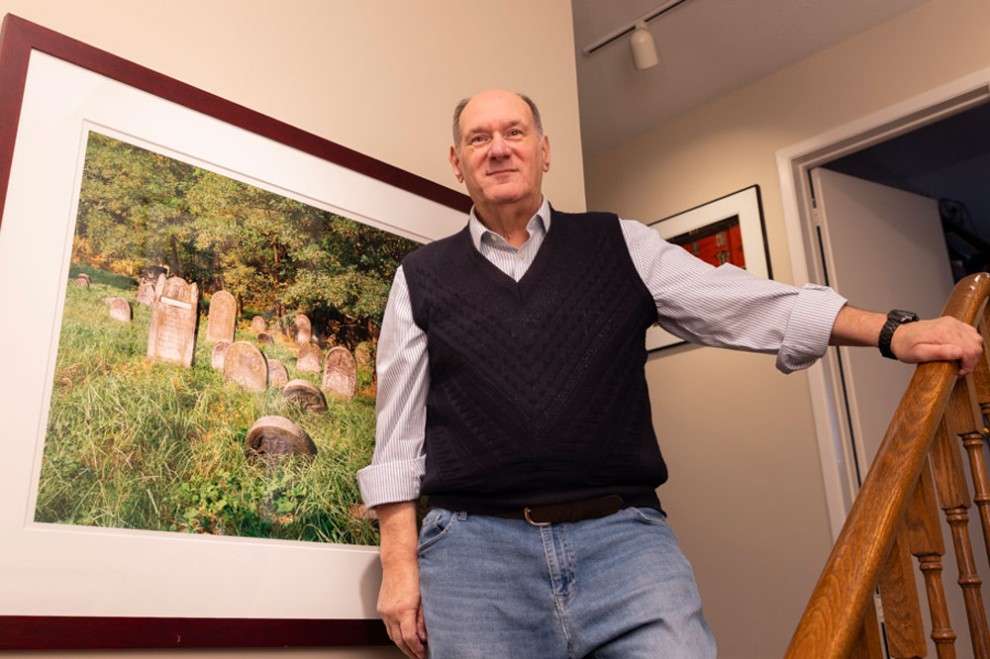
David Kaufman has spent his life telling stories. From his days growing up in Montreal, when he dreamed of a career in folk music, to his years producing documentaries for the CBC, to his more recent work documenting the legacy of Jewish communities across Eastern Europe, the Toronto filmmaker and architectural photographer has consistently been drawn to people, places, and histories at risk of being forgotten.
The story Kaufman tells in his 2025 coffee table book, The Posthumous Landscape: Remnants of Jewish Life in Eastern Europe, is of a civilization largely destroyed in the Holocaust, yet one that continues to speak through the cemeteries, synagogues, and buildings that remain. Produced using a large-format architectural camera, his photographs capture extraordinary detail of elaborately carved tombstones emerging from overgrown Jewish cemeteries, restored synagogues standing in towns without Jews, and landscapes forever scarred by mass murder.
The origins of Kaufman’s passion project can be traced to a high school soccer field in a small town outside Warsaw, where he came upon a pile of weathered Jewish tombstones. The encounter took place in 1992, when Kaufman, now 78, was in Poland filming a documentary on child survivors of the Holocaust for CBC’s investigative program, The Fifth Estate.
“I had never seen Jewish gravestones of such beauty,” he recalled. “The calligraphy was beautiful, and the artwork at the top of the gravestones was beautiful. And this made a huge impression on me.”
Kaufman returned to Poland twice more in the years that followed to produce documentaries on the Warsaw and Łódz ghettos before devoting himself fully, beginning in 2007, to photographing cemeteries, synagogues, and other surviving traces of Jewish history across Poland and the broader region.
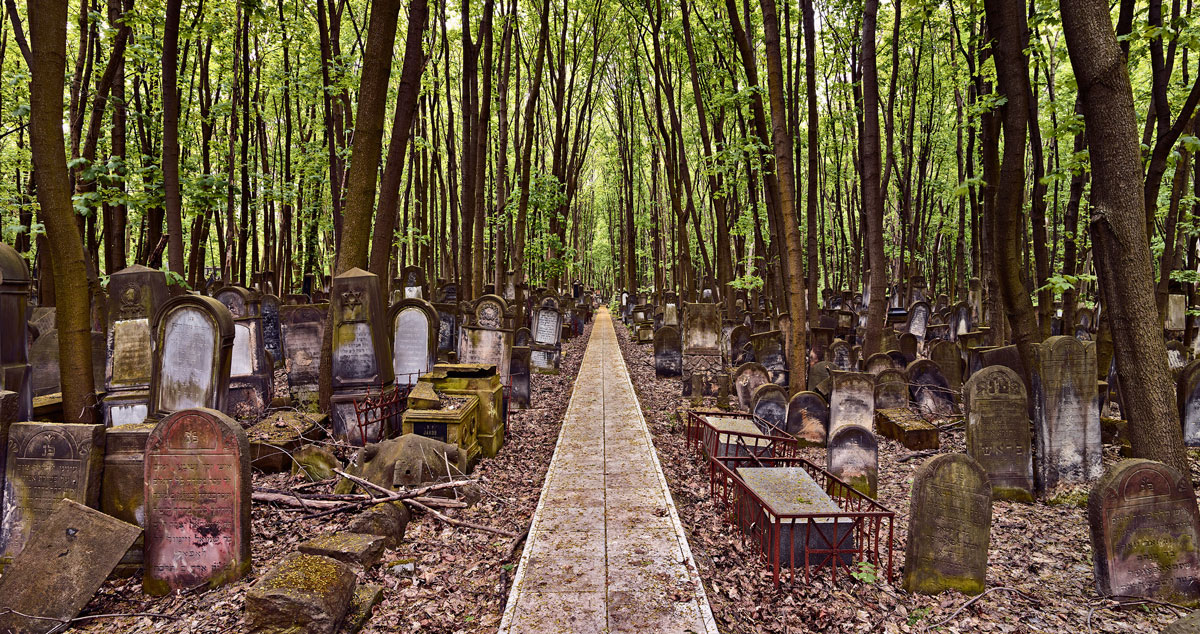
His book opens with photographs of the vast Jewish cemeteries of Warsaw and Łódz, each of which contains hundreds of thousands of burial sites, including individual and mass graves of Holocaust victims. Kaufman’s images capture the untamed character of these landscapes, where rows of intricately carved tombstones compete for space with dense, uncontrolled vegetation.
Yet the photographs also reveal a striking contrast between the two cities. Little remains of Warsaw’s once vibrant Jewish world beyond its cemetery and the Monument to the Warsaw Ghetto Fighters, erected shortly after the end of the Second World War, while in Łódz, by contrast, buildings from the former ghetto remain remarkably intact, as well as the sprawling textile empire and grand residence of the nineteenth-century Polish-Jewish industrialist and philanthropist Israel Kalman Poznanski, whose grand mausoleum in the Lodz cemetery stands as a reminder of the wealth and cultural vitality once enjoyed by the city’s Jewish community.
Kaufman also photographed several small, often unmarked Jewish cemeteries in towns across Poland, locating them through a combination of his own research and the assistance of Poles he and his wife encountered along the way. On one occasion, after asking a woman at a playground for the Polish word for “cemetery,” she immediately pulled out her phone and made a call.
“Ten minutes later, the person in charge of the cemetery pulls up on a bicycle and takes us there,” Kaufman recalled. “You could do that almost anywhere in Poland because people are genuinely welcoming to Jewish visitors.”
The experience brought to mind a conversation Kaufman had during his first trip to Poland, when the caretaker of Warsaw’s Jewish cemetery explained that much of the early preservation work at neglected Jewish cemeteries in small towns had been undertaken by people who themselves felt like outsiders. Some were young gay men who took it upon themselves to protect cemeteries from vandalism, illegal dumping, and encroachment by neighbouring farmers. Others were high school teachers interested in local history, or municipal officials who recognized the value of preserving heritage sites. Since the fall of communism, said Kaufman, a growing number of Poles have become interested in learning about a community who were such an important part of their country’s history.
Kaufman’s photographs of restored synagogues in Poland, Ukraine, and Lithuania are particularly beautiful, revealing the remarkable diversity of Eastern European synagogue architecture. Some, such as the seventeenth-century synagogue in Lesko, a town in southeastern Poland, were built in the style of a “fortress synagogue,” designed to serve both as a house of worship and as a place of refuge during periods of unrest. Others, including the Great Synagogue of Tykocin and the synagogue in Łancut, feature vaulted ceilings supported by four central columns, their interiors richly decorated with Hebrew inscriptions, ornamental motifs, and zodiac symbols.
The fate of the seventeenth-century Great Synagogue of Zamosc is representative of many of the region’s surviving synagogues. Severely damaged during the Nazi occupation, it was later rebuilt under Communist rule and converted into a public library. In 2000, the building was returned to the Jewish community and subsequently restored under the auspices of the Foundation for the Preservation of Jewish Heritage in Poland. Today, it serves simultaneously as a prayer space, museum, and cultural venue.
Kaufman and his wife would ultimately travel to roughly 50 locations across Poland, Ukraine, and the Baltic states over a decade of travel, experiences that led him to conclude that the Holocaust was a local phenomenon.
“Everywhere you go, you understand that there were local heroes and local collaborators, people who were willing to turn against their Jewish neighbours to help in their murder or their deportation.” But the landscape itself still bears witness to the communities that once lived there, Kaufman said.
“Even if it’s an empty field, there may be a cemetery … or remnants of a synagogue, and people locally will know where those places are,” he said. “So the task of preserving Jewish artifacts in Eastern Europe is just enormous … and the resources available are completely inadequate. So everywhere that some synagogue is restored or a cemetery is saved or restored, is a miracle.”
Kaufman views his photography not only a record of what was destroyed, but testimony to what remains. In that sense, the project is driven by urgency as much as observation — an effort to preserve and make visible the traces of Jewish life in Eastern Europe before they disappear forever.
The Posthumous Landscape: Remnants of Jewish Life in Eastern Europe, can be ordered from davidkaufmanphotography.com, online retailers and local bookstores.
Click here to see a photogallery of David Kaufman's images
