
April 2026
Michelle Daleo
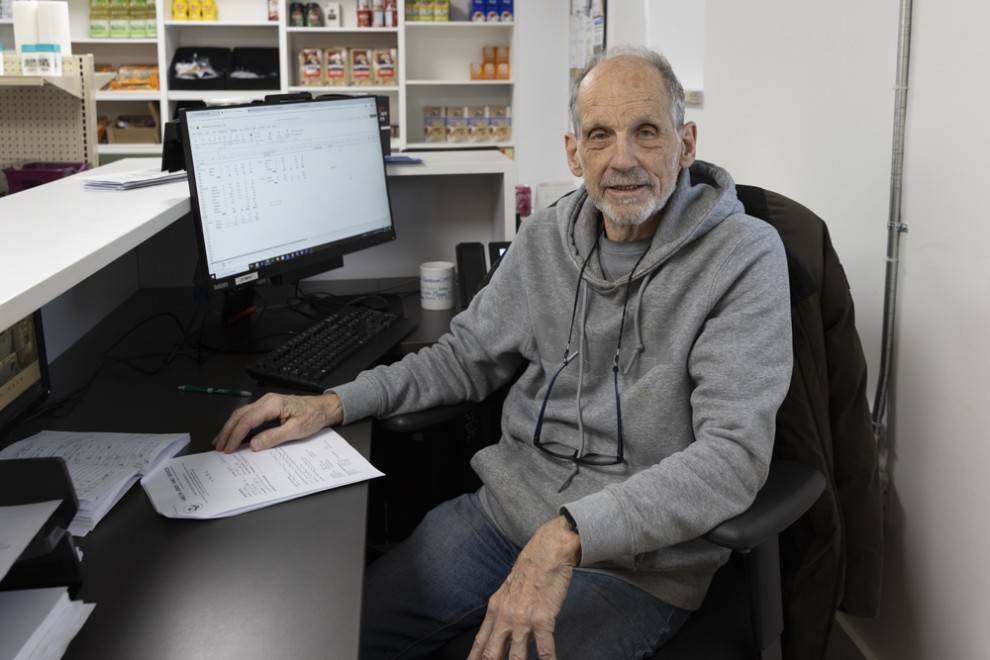
When Lloyd Orson talks about his work at Hamilton Jewish Family Services’ food bank, he doesn’t begin with logistics or numbers. He begins with people.
“Most of them want to vent,” he says. “They don’t want to hold everything in. And I listen.”
At first glance, Lloyd’s job might seem straightforward: arrange appointments, coordinate deliveries, keep shelves stocked, make sure food gets where it needs to go. He has been doing this work for just over four years, after many years of volunteering with deliveries and community garden work. But spend time with him, and it becomes clear that what he really delivers is something else entirely.
Connection.
Lloyd arrived in Hamilton from Toronto 57 years ago, building his life within the Jewish community. That long history here shapes how he sees his work today. The food bank, for him, is not simply a service. It is an extension of community, of responsibility for one another.
“Most of these people are like friends and family now,” he says.
His days are filled with conversations as much as coordination. Clients share stories of job loss, rising bills, illness, separation, loneliness. Some are seniors on fixed incomes. Increasingly, many are young families. Quite a few are working two or three jobs and still falling short.
“It’s becoming worse,” Lloyd says quietly. “People are really trying.”
The stereotype of who needs a food bank no longer fits. The people Lloyd sees are often employed, often educated, often doing everything they can to stay afloat in an economy that feels unforgiving.
At the same time, the food bank faces its own pressures. Maintaining sufficient quantity has become more challenging as prices climb. Some initiatives have had to be scaled back, underscoring how essential community donations remain.
“Canned goods, cereals, kosher staples, those make a big difference,” Lloyd says. “Programs like school and shul food drives are incredibly helpful.”
And while food insecurity is the visible need, Lloyd understands that hunger is rarely just about food.
“Food is one part,” he explains. “If someone needs more help, we connect them.”
Through Jewish Family Services, individuals can access counseling, social services, and additional resources, ensuring that food insecurity is addressed alongside the complex challenges that often accompany it.
Still, it is not systems that define his work. It is moments. He recalls a man who had recently arrived in Canada and was separated from his wife due to circumstances beyond his control. The man was struggling, financially and emotionally. After helping him with groceries, Lloyd later returned with something unexpected: a menorah and Hanukkah candles.
“He started to cry,” Lloyd says. “He told me no one had ever done something like that for him.”
For Lloyd, it was a small gesture. For the client, it was a reminder that he was seen, not just as someone in need, but as a person with identity and dignity.
There are hard days too. Long-time clients facing illness. People overwhelmed by life’s sudden turns. Moments when Lloyd wishes he could fix more than he can.
“Sometimes you feel like you want to do more,” he admits.
But he shows up the next day anyway.
In Jewish tradition, caring for others is a responsibility. Lloyd does not speak in grand terms about values or philosophy. He simply lives them. Quietly. Consistently. He organizes shelves. He maps delivery routes. He answers calls.
And he listens.
“This experience has opened my mind,” he says thoughtfully. “I’m just thankful.”
In a world that often feels rushed and impersonal, Lloyd’s approach is disarmingly simple. He treats people like family. He makes space for their stories. He remembers the small details that matter.
The food he helps distribute fills cupboards. The conversations he offers fill something else. And for many in Hamilton’s Jewish community, that may be the most important nourishment of all.
Michelle Daleo is a member of the HJFS board of directors, as well as the committee chair for the organization’s Kosher Food Bank.
