
Sept. 2026
Jen Gilbert
Life moves fast, especially when we’re busy. For Israeli-born artist Chani Rothschild, work ethic and productivity were ingrained in everyday life from a young age; they were simply the norm.
“Why are you sitting idle?” her mother would ask whenever Rothschild was doing nothing. That mindset stayed with her, carrying her through multiple careers, motherhood, moves between countries, and a lifelong commitment to making art.
Rothschild’s journey eventually brought her to Hamilton, where she found a home at Beth Jacob Synagogue. “You have a piece of my heart there,” she said fondly. It was there that her curatorial career first took shape. But more on that later. For now, let’s go back to the beginning.
Rothschild was meant to be an artist. She approaches art in a way that’s original, thought-provoking, and instinctual. She’s always been a creator, even as a child, encouraged by her parents to paint, taught by her father to weld; it was never in an organized, sign-up-your-kid-for-art-classes kind of way. “I think I always created in a different way,” she said. In their spare time her parents were creators, so naturally Rothschild was aligned with this way of life. She wanted to study art in school, but sought a practical profession, studying industrial design at Bezalel Academy of Art and Design in Jerusalem. After graduation, she worked as an art director designing entertaining information — infotainment — for kids.
She became a teacher, studied carpentry, moved to Canada, studied art therapy, worked with refugees in Hamilton, obtained her Master’s in Social Work, worked as a clinical therapist, and finally studied curatorial studies in Israel, where she now works as a curator. It’s safe to say she doesn’t sit idle.
When Beth Jacob received a donation to purchase an artwork, Rothschild proposed a different idea. “Let’s make this wall into a gallery,” she said. The result was a community art space that brought together Jewish and non-Jewish artists, featuring local talent alongside Israeli artists living in Ontario. “I just wanted to bring artists [together], write about them, and engage the community,” she said. “I think as a social worker, I do things for the community, and they somehow always involve art. So it’s a way of connecting and a place for people to share their stories.”
At the same time, Rothschild was creating her own art, using it to explore emotions that often lay beyond words. Her art is a language that taps into the nonverbal; it’s a gateway to understanding her feelings, feelings from which she often felt detached. When she creates, she does so entirely for herself. Her work serves as a diary, tracing the story of her life.
Expressing her feelings in an obvious, expected way isn’t how Rothschild works, and perhaps this is a key to her success. No one has ever done what she’s done, and she never knows what’s going to come out of her projects. Leaning into her instincts is how she starts. “I’m walking into the unknown, and I just have to trust that I’ll know something good will come out of it,” she said. And although her intentions are to find meaning for herself, others have found her work meaningful — a wonderful side-effect.
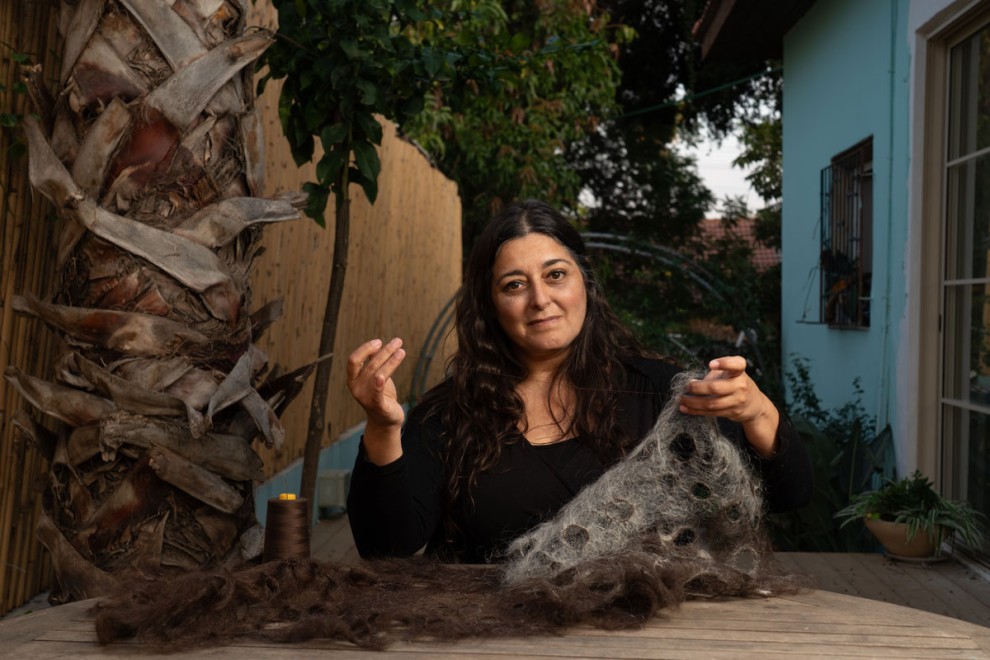
Rothschild is happiest when her work raises questions and elicits a visceral response. She enjoys when people feel something, whether they’re unsettled or unsure of exactly what they’re looking at. Her latest work, Why are you sitting idle?, does just that. The multi-generational piece weaves together human hair — a material that holds memory and meaning — while inviting reflection on the relationship between life and death, where the human spirit resides, and what materials are considered acceptable to work with.
After moving back to Israel in 2020, Rothschild spent six years collecting hair — her own, her mother’s, and her daughter’s. The resulting work explores what she describes as the DNA of labour. To Rothschild, hair is a living material, carrying memory, time, and generations of work within a single strand. By collecting, sewing, and embroidering with hair, she transforms an intimate biological material into a language of memory, identity, and continuity. The piece records stories of female diligence, constant movement, and the need to hold, repair, and carry on — stories that can’t always be spoken.
Today, Rothschild believes deeply in the importance of personal voices. She values artists who are willing to be brave, speak honestly, create work that matters, and share it with the world. But after a lifetime of motion, she has also learned the importance of stillness. There’s benefit to allowing our brains to just be and heal, she says, giving room to thoughts that weren’t there before.
These days, Rothschild finds herself balancing both impulses: working on a new project exploring her relationship with her mother, who died in December 2025, while also reminding herself to slow down, sit still, and let her mind wander.
You can view more of Rothschild’s work at www.rothschildhannah.com. Why are you sitting idle? is currently on exhibit at Eretz Israel Museum, curated by Galit Gaon & Henrietta Eliezer Brunner, until Nov. 30.
Photo: Yael Lichtenstein, Tel Aviv Biennale of Crafts and Design: Works and days, Muza, Eretz Israel museum, Tel Aviv
